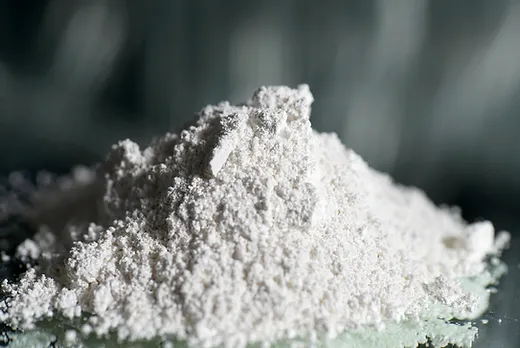
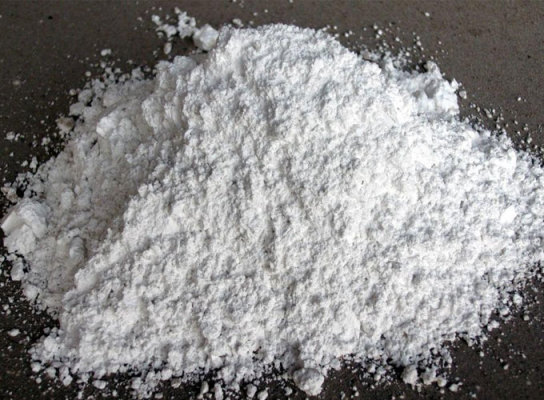
Quick facts:
| Property |
Detail |
| Chemical formula |
Ca(OH)₂ |
| IUPAC name |
Calcium Hydroxide |
| Common name |
Slaked Lime |
| Molecular weight |
74.093 g/mol |
| Density |
2.211 g/cm³ |
| Appearance |
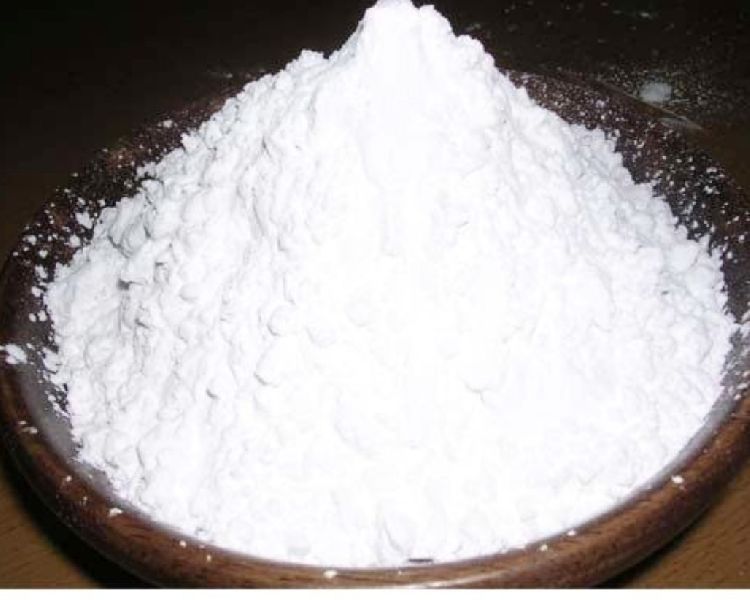
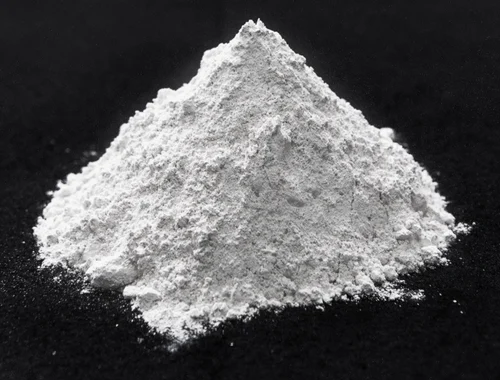
White powder or colorless crystal |
| Melting point |
853 K |
| Acid insoluble (as SiO₂) |
0.20 ± 0.60 |
How Is Slaked Lime Produced?
Slaked lime is produced by reacting calcium oxide (CaO) with water (H₂O). The reaction is strongly exothermic — it releases a significant amount of heat:
CaO + H₂O → Ca(OH)₂ + Heat
This is the same slaking reaction that produces hydrated lime; "slaked lime" and "hydrated lime" are two names for the same result. What differs in practice is the form the output takes, depending on how much water is used and how the reaction is managed:
- Dry hydrate (powder): produced when just enough water is added to convert the CaO fully without excess moisture — a fine, dry, workable powder.
- Milk of lime: produced when more water is added to the dry hydrate, creating a liquid suspension.
- Limewater: the clear liquid obtained when milk of lime is allowed to settle or is filtered, leaving only the dissolved calcium hydroxide in solution.
- Lime putty: produced by slaking with excess water and allowing the mixture to mature over time (traditionally weeks to months), yielding a smooth, plastic paste long favored by traditional builders and conservationists for lime plaster and mortar work.
Understanding which form you need is often the first practical decision for anyone sourcing slaked lime — dry powder for most industrial dosing, or a wet form (putty, milk of lime) for traditional construction and specialist plasterwork.
Properties of Slaked Lime
- Crystalline structure in its pure solid form
- Slightly soluble in water — forms limewater when dissolved, with undissolved solids settling as milk of lime
- Hygroscopic — absorbs moisture from the air, which is why dry storage matters for shelf life
- Strong base — effective at neutralizing acids and raising pH
- Stable under normal conditions, though it will gradually absorb atmospheric CO₂ and revert toward calcium carbonate over long exposure
Uses of Slaked Lime
Construction
Slaked lime is a foundational material in traditional and modern construction — used in mortar, plaster, whitewash, and (in its putty form) in lime-based renders favored for heritage and breathable-wall construction. Its binding properties and workability are why it has remained in use for millennia.
Agriculture
Applied to acidic soils, slaked lime neutralizes excess acidity and improves fertility, helping crops access nutrients more effectively and supporting better yields.
Water Treatment
Slaked lime is used in water purification to remove impurities and in water softening, where it helps precipitate hardness-causing minerals out of solution.
Neutralizing Chemical
Its strong alkalinity makes slaked lime an effective neutralizing agent across various industrial processes that generate acidic byproducts.
Paper Industry
Slaked lime plays a role in pulp and paper processing, including chemical recovery steps used to regenerate processing agents.
Paint Production
Slaked lime is used in the production of certain paints, notably traditional limewash, valued for its breathable, matte finish.
Pesticides
Slaked lime is utilized in the production of certain pesticide formulations, where its alkalinity supports specific chemical processes.
Food Industry
In smaller-scale or traditional use, slaked lime is sometimes used in pickling processes and as a preservative.
Benefits of Slaked Lime
- Cost-effective and easy to use across a wide range of applications
- Environmentally friendly option for water and waste treatment
- Improves soil fertility and crop yield when used for agricultural liming
- Enhances the durability of construction materials
- Readily available in multiple forms — powdered, putty, and slurry — to match different use cases
Slaked Lime vs. Hydrated Lime — Are They the Same Thing?
Yes — chemically, slaked lime and hydrated lime are identical, both referring to calcium hydroxide, Ca(OH)₂. The difference is mostly in usage convention rather than chemistry:
| |
Slaked Lime (common usage) |
Hydrated Lime (common usage) |
| Chemistry |
Ca(OH)₂ |
Ca(OH)₂ — same compound |
| Typical context |
Traditional construction, agriculture, general/informal use |
Industrial and technical specification sheets — water treatment, steel, chemical manufacturing |
| Common physical forms discussed |
Dry powder, milk of lime, limewater, lime putty |
Primarily dry powder, graded by purity (%) and mesh size |
| Where to find detailed grade specs |
This page (general use) |
Hydrated Lime page (70–94% grade table, mesh specifications, technical data) |
If you need detailed industrial grade specifications, purity percentages, particle mesh sizing, or bulk order/pricing information, our Hydrated Lime page covers that in full technical depth. This page focuses on slaked lime as a material concept, its traditional forms, and general applications.
Slaked Lime vs. Quick Lime — What's the Difference?
| |
Quick Lime (CaO) |
Slaked Lime (Ca(OH)₂) |
| Production |
Made by calcining (heating) limestone |
Made by adding water to quick lime |
| Reactivity |
Highly reactive, generates significant heat with water |
Stable, safer to handle |
| Handling |
Requires more caution |
Easier to store and use directly |
| Typical use |
Steel flux, feedstock for slaked lime production |
Construction, agriculture, water treatment, food processing |
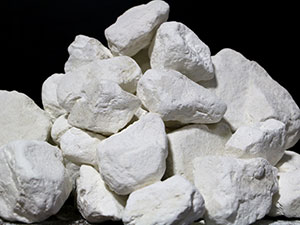
In short: quick lime is the raw, unstable starting material; slaked lime is what you get once it's safely reacted with water. See our Quick Lime page for details on the lump-form raw material.
Safety Precautions
Slaked lime is a useful and generally lower-hazard compound compared to quick lime, but it should still be handled with care:
- Wear protective clothing, gloves, and eye protection
- Avoid inhaling dust
- Store in a cool, dry place, away from moisture and acids
- In case of skin or eye contact, rinse immediately with clean water and seek medical attention if irritation persists
Common Questions Buyers Have Before Sourcing Slaked Lime
- Do I need dry powder or a wet form (putty/milk of lime)? Most industrial and agricultural applications use dry powder for ease of transport and dosing; traditional construction and specialist plasterwork often specifically call for lime putty.
- Is "slaked lime" the same product as "hydrated lime" from a technical spec sheet? Yes, chemically — if you're comparing a slaked lime product to a hydrated lime product with the same purity and mesh size, they're the same material.
- How should I store it? Slaked lime is hygroscopic, so dry, sealed storage is important to prevent moisture absorption and preserve shelf life.
- Is a sample worth requesting? Yes — as with any lime product, requesting a sample before a bulk order helps confirm consistency and fit for your specific application.
Sourcing Slaked Lime from Shivi Minerals
Shivi Minerals is one of the leading slaked lime manufacturers, suppliers, and exporters in India, based in Jodhpur, Rajasthan. We produce slaked lime through a controlled slaking process, giving customers a consistent, high-purity product suited to construction, water treatment, agricultural, and general industrial use.
Why buyers choose us as a slaked lime manufacturer:
- Cutting-edge production methods focused on high purity and consistent efficacy
- Supply relationships across construction, water treatment, agricultural, paper, and chemical sectors
- Product suitable for neutralizing acids, water softening, and soil pH correction
- Direct manufacturer relationship — no intermediary markups
Get a quote or request a sample: Contact us with your required specification and volume.